
Yeast Extract Is Not Monosodium Glutamate
Recently, there has been a flood of information about monosodium glutamate (MSG) circulating online and in television programs. Most of these sources emphasize its alleged harmfulness – however, as food producers, we do not wish to comment on this topic, as we are neither scientists nor medical professionals.
We do feel the need to respond, though, to one significant piece of misinformation: the claim that MSG and yeast extract are one and the same. Some articles even speak of “dishonest practices” by manufacturers who allegedly hide MSG under names like “yeast extract”, “nutritional yeast”, or “soy hydrolysate”.
MSG and yeast extract are not the same thing
This claim is just as misleading as saying “tea and caffeine are the same” or “ripe fruit and alcohol are the same.” The confusion likely stems from the fact that MSG can be produced from yeast extract—because, like other protein-rich ingredients, yeast contains glutamic acid. However, the amount of glutamic acid in yeast is relatively low; in dried yeast, it typically reaches only a few percent and varies depending on the strain.
There are many foods with a naturally higher content of glutamic acid or its salts—such as tomatoes, seaweed, or cheese. Yet we don’t label them as “MSG.”
What Is Monosodium Glutamate (MSG)?
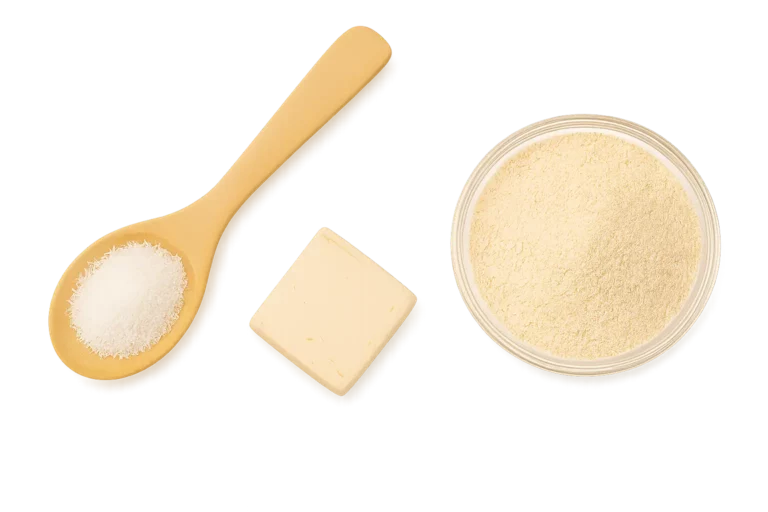
Monosodium glutamate (MSG) is the general name for the salt of glutamic acid, most commonly known in the Czech Republic as “glutaman sodný.” It is a white, crystalline powder with no distinct taste on its own. MSG is produced industrially from yeast or other protein-rich raw materials by extracting glutamic acid, which is then neutralized to form glutamate. In the past, MSG was made from seaweed due to its naturally higher glutamic acid content, but this method proved more expensive.
The term “glutamate” refers to pure, nearly 100% glutamic acid or its salts. It is synthetically produced and added to foods to enhance their flavor.
What Is Yeast Extract?
Yeast extract is produced by the breakdown of yeast (whether baker’s, brewer’s, wine, or other types) – similar to, for example, soy sauce. By changing the conditions of this breakdown, manufacturers can achieve different flavor profiles.
Yeast extract has a brown color (it can be in liquid form, as a paste, or powder) and always has a strong aroma and taste – similar to soy sauce. By the way, soy sauce also naturally contains glutamic acid, even in its natural variant. Depending on the type of yeast used, yeast extract contains various amino acids, minerals, vitamins, and other substances. Yeast extract naturally contains glutamic acid, but in low amounts (a few percent).
Our Commitment to Natural Ingredients
In some of our products, we use naturally fermented Shoyu soy sauce and yeast extract to add flavor to our soy and buckwheat products. However, this does not mean that we add pure glutamate to them. Therefore, they do not have an increased glutamic acid content like products to which glutamate is intentionally added.
Sources:
Biochemička – https://www.biochemicka.cz/clanek-19/glutamat
FÉR potravina – https://www.ferpotravina.cz/seznam-ecek/E620
FÉR potravina –https://www.ferpotravina.cz/seznam-ecek/E621