
Thickeners in Our Products: Why We Use Them and What You Should Know
In some of our product recipes, you may find thickeners such as carrageenan, guar gum, methylcellulose, and xanthan. Many articles about their effects can be found online, which is why we decided to explain why we use them and clarify their properties.
Why Do We Use Thickeners?
The reason we add these thickeners to some of our products is purely technical and practical. The manufacturing process requires the mixture to have the right consistency during production.
Small amounts of thickeners help us achieve the ideal density, which allows us to easily fill our products into packaging. After heat treatment, they also achieve a consistency that remains stable throughout their entire shelf life.
Safety and Regulations
As manufacturers of plant-based alternatives, we are careful when selecting every ingredient we use. The use of carrageenan (E407), guar gum (E412), xanthan (E415), and methylcellulose (E461) in foods is approved and permitted in necessary quantities in the Czech Republic, throughout the European Union, and in the United States. Carrageenan may be used in both adult foods and foods intended for children.
Possible Side Effects
Research has shown that thickeners may cause flatulence and intestinal problems when consumed excessively. This is precisely why relevant authorities regulate the amounts used in individual foods.
We can illustrate this issue using dried plums as an example. The fiber they contain helps regulate bowel movements and alleviate constipation. However, in excessive amounts, it can cause digestive problems. Thickeners work on a similar principle.
Individual Thickeners
1. Carrageenan (E407)
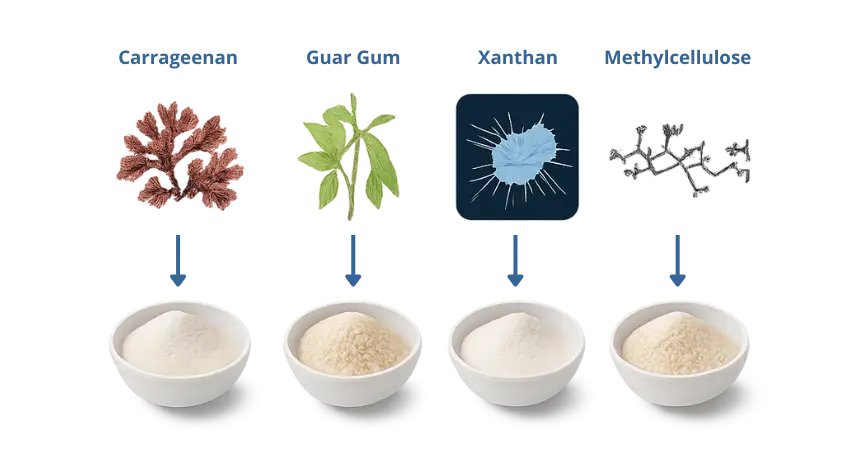
Carrageenan is a natural plant-based substance commonly used in the food industry. It is extracted from red seaweed of the species Chondrus crispus, also known as Irish moss. In the form of white powder, it can create a transparent gel when mixed with water and heated – similar to its “relative” agar-agar.
Studies and research have not proven carrageenan to be carcinogenic. It has even been shown to potentially lower cholesterol levels.
2. Guar Gum (E412)
Guar gum is a natural plant-based substance obtained from the seeds of the Cyamopsis tetragonoloba plant (guar). It is grown primarily in India and Pakistan. In the form of fine cream-colored powder, it can create a viscous solution with excellent thickening properties when mixed with water – even when cold, without the need for heating.
It is a natural polysaccharide that slows the absorption of sugars and fats, which may help reduce cholesterol and blood sugar levels. It also functions as a prebiotic in intestinal microflora.
3. Xanthan (E415)
Xanthan is a natural substance obtained through a fermentation process in which Xanthomonas campestris bacteria convert natural sugars into a unique polysaccharide. In the form of fine light powder, xanthan can create a stable solution with remarkable thickening properties when mixed with water – even in small quantities and regardless of temperature.
This natural thickener is considered safe. It may also help regulate blood sugar levels and support gut health.
4. Methylcellulose (E461)
Methylcellulose is a synthetic substance obtained through chemical modification of cellulose – natural plant fiber. It forms a fine white powder that creates a viscous solution with exceptional thickening properties when mixed with water. It is characterized by high stability and effective performance across a wide temperature range.
Due to its versatility, it finds applications not only in modern gastronomy but also in the cosmetic and pharmaceutical industries. Its unique ability to create gels and emulsions without the need for heating makes it an ideal ingredient for a wide range of applications requiring specific consistency.
Methylcellulose is generally considered safe because its toxicity is low and it is not absorbed into the body. It may regulate cholesterol and blood sugar levels and help maintain regular bowel movements.
Conclusion
We use thickeners in our products purely for technical reasons – they help us create products with ideal consistency and stability. We use all of them in small, safe quantities according to current regulations. We believe that transparency regarding the composition of our products will help you make informed food choices for you and your family.
Sources:
Asian Journal of Medicine and Health – https://journalajmah.com/index.php/AJMAH/article/view/1183
Bakalářská práce na téma Charakteristika vybraných doplňků stravy z hlediska složení a fyziologického vlivu na člověka, autor Kristýna Uhrová, 2020, Přírodovědecká fakulta UNIVERZITA PALACKÉHO V OLOMOUCI – https://theses.cz/id/1fqon7/Bc.-prace-Final-1.pdf
Bakalářská práce na téma Charakterizace karagenanu densitometrií, autor Halina Poledňáková, 2015, Fakulta chemická – Ústav fyzikální a spotřební chemie, VYSOKÉ UČENÍ TECHNICKÉ V BRNĚ – https://www.vut.cz/www_base/zav_prace_soubor_verejne.php?file_id=100753
FÉR potravina – https://www.ferpotravina.cz/seznam-ecek/E412
FÉR potravina – https://www.ferpotravina.cz/seznam-ecek/E415
FÉR potravina – https://www.ferpotravina.cz/seznam-ecek/E407
FÉR potravina – https://www.ferpotravina.cz/seznam-ecek/E461
Healthline – https://www.healthline.com/health/food-nutrition/cellulose-gum
National Library of Medicine – https://pmc.ncbi.nlm.nih.gov/articles/PMC3545536/
National Library of Medicine – https://pmc.ncbi.nlm.nih.gov/articles/PMC3066369/
Státní zemědělská a potravinářská inspekce – https://www.szpi.gov.cz/clanek/-ecka-a-dalsi-latky-v-potravinach-pridatne-latky-aditiva.aspx
Our articles are prepared under the expert supervision of a medical doctor Ľuba Lapšanská.