
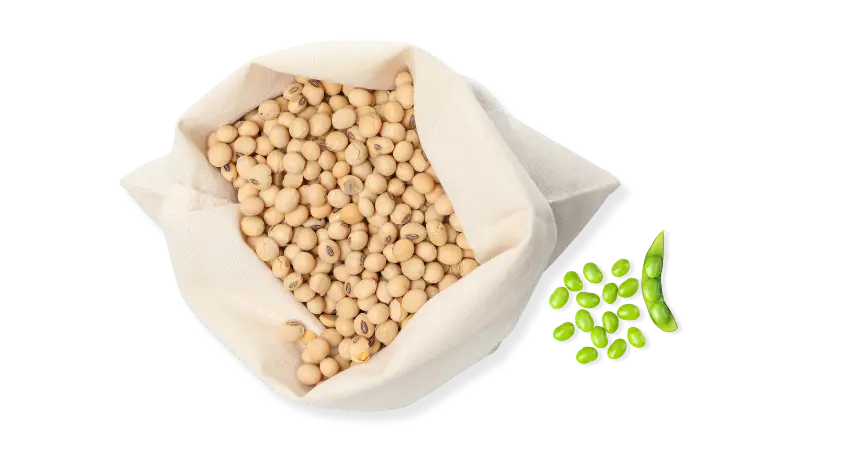
Soy, the queen of all crops
“Today’s much-discussed and still somewhat mysterious legume, soy, captivated us in the 1990s with its nutritional benefits. It is, therefore, a fundamental raw material for the production of our premium pâté range PÂTIFU and Vegi Steak meat alternatives.”,
Marek Petráček and Petr Böhm, Managing Directors
A Gem That Many Doubt
Tofu is now a staple in the food industry, and its production from soybeans is well-known. However, soy itself remains somewhat of a mysterious crop for many. In the Czech environment, where fields of grains, corn, rapeseed, poppies, or peas dominate, we could easily overlook it. There is also some uncertainty about its proper inclusion in the diet. Furthermore, we encounter conflicting expert opinions about its health benefits. Although soy is truly a treasure among legumes when processed and consumed correctly, many still underestimate its potential. Let’s take a closer look at it now.
The History of Soy Dates Back to Ancient Times
Soy has deep roots in Asian history. According to Chinese tradition, soybeans were among the five sacred crops during the reign of Emperor Sheng-Nung, who mentions them in his manuscript from 2,838 BC. However, some historians date its systematic cultivation by Chinese farmers to around 300 BC. At that time, along with millet, it regularly appeared in Northern Chinese documents as one of the main agricultural crops. Over time, its cultivation spread to Southern China, Korea, Southeast Asia, and Japan.
The journey of soy to the Western world is not clearly mapped in history. There are several theories—one speaks of European sailors using soy plant sacks to transport goods from China, another attributes its spread to Chinese immigrants or European scientists who were so intrigued by this crop that they began to study it. In the Western world, including America, soy was initially considered more of a curiosity.
A pivotal moment in the history of soy came with Dr. John Harvey Kellogg, a pioneer of vegetarianism. Not only did he replace the traditional breakfast of eggs and bacon with cornflakes and granola, but in 1919, he published a significant work on the benefits of soy in the diet of diabetics. By the 1920s, he was already successfully trading the first soy products. Later, in collaboration with other vegetarian pioneers from the Seventh-Day Adventist Church, he developed other innovative products, including soy-based meat alternatives.
Dr. A. H. Horvath, also known as the “Father of Soy,” also played an important role in spreading soy in America. His scientific work from 1931, Soy Flour as a National Food, and his efforts to include this legume among the major agricultural crops of the USA had remarkable results—within just 15 years, the area planted with soy increased by more than seventy-fold.
Recognizing Soy in the Field Is Easy
As mentioned earlier, soy is a legume. Soybeans mature in slightly hairy green pods, usually containing two to three round seeds. The plant itself has a bushy growth habit and reaches a height of 30 to 60 centimeters.
The harvest of soybeans typically occurs when they are fully ripe or when they are dry. At this stage, they are yellow, although some varieties may also be brown or black. In Asian countries, it is also common to harvest them at about 75% maturity, when the beans are fully developed but still green.
A Legume That Serves as Food for People and Animals
Over time, soy has earned a significant position primarily as an excellent source of high-quality plant-based protein. Unlike animal products, it does not burden the body with cholesterol or unhealthy fats. Its composition is still the subject of intense scientific investigation, especially regarding phytoestrogens, protease inhibitors, soy carbohydrates, and phytates. However, existing research confirms its exceptional properties. Thus, soy is not only a valuable source of proteins and oils but also of significant phytochemicals that have a proven positive effect on the human body.
Soy also plays a key role in the animal feed industry. More than 80% of global production is directed towards animal feed mixtures for livestock.