
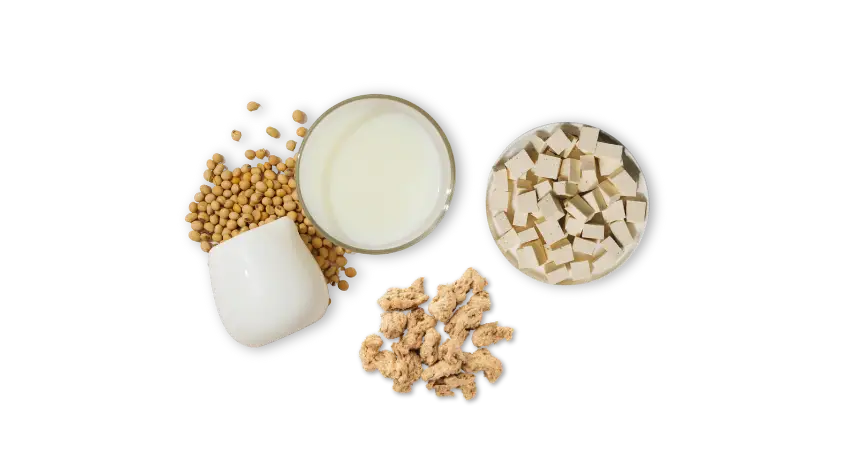
Soy: A Source of High-Quality Protein and Other Benefits
“In a world where healthy eating is not just a trend but a necessity, soy is rightfully gaining more and more attention. Its positive – or at least neutral – nutritional properties are supported by numerous scientific studies.”,
Marek Petráček and Petr Böhm, Managing Directors
Facts About Soy: What We Really Know
As a company with many years of experience in producing plant-based soy products, we often encounter questions and myths surrounding this legume. That’s why, under the factual supervision of Dr. Ľuba Lapšanská – whom we sincerely thank – we have prepared a comprehensive article based on the latest scientific findings.
Let’s start with what soy is not. It is not a “hormonal bomb” – the isoflavones in soy have effects many times weaker than human estrogen. It is false that soy causes feminization in men – extensive studies have disproven this. And finally, high-quality soy does not have to be genetically modified – certified organic options are available.
On the contrary, soy is one of the most complete plant-based sources of nutrition, with a millennia-long tradition of consumption in Asian countries where it is a staple food among populations with some of the longest average lifespans in the world.
Let’s take a look at some numbers
| Nutritional content per 100 g of soy | |
|---|---|
| Calories (kcal) | 1,870 kJ / 446 kcal |
| Fat | 20 g |
| Saturated fatty acids | 2.9 g |
| Carbohydrates | 30 g |
| of which sugars | 7 g |
| Protein | 36 g |
| Fiber | 9 g |
| Cholesterol | 0 mg |
| Sodium | 2 mg |
| Potassium | 1,797 mg |
| Vitamin C | 6 mg |
| Vitamin B6 | 0.4 mg |
| Magnesium | 280 mg |
| Calcium | 277 mg |
| Iron | 15.7 mg |
A Protein Powerhouse from the Plant World
Proteins are the building blocks of our body – they are essential for the formation of bones, muscles, and organs, support the immune system, and ensure the transport of nutrients and oxygen. Out of the 20 known amino acids, the human body can synthesize 11 on its own. The remaining 9, known as essential amino acids, must be obtained through diet.
Soy stands out as it contains all 9 essential amino acids, making it a complete plant-based source of protein. For a well-balanced diet, it is recommended to combine soy with other plant-based protein sources such as grains and seeds rich in methionine – an amino acid that soy contains in smaller amounts.
💡 Did you know that the average adult should consume approximately 0.8 grams of protein per kilogram of body weight daily? Including soy in your diet can help you easily meet this requirement.
Natural support for a healthy heart and balanced cholesterol
Not all fats are created equal – but healthy fats are a cornerstone of good nutrition. Soy contains approximately 20 % fat, with only about 15 % of it being saturated. That means the majority consists of healthier unsaturated fats, which can have a positive impact on cardiovascular health.
Prebiotic Power of Soy: Nutrition for Your Microbiome
You might be surprised to learn that soy contains three specific sugars – stachyose, verbascose, and raffinose. The body cannot directly digest these substances. They travel all the way to the large intestine, where they may cause mild bloating in more sensitive individuals, but primarily serve as quality food for beneficial bifidobacteria. Consuming soy can therefore support the growth of beneficial probiotic bacteria and limit the number of harmful microorganisms in the digestive tract.
Fiber for Healthy Digestion
Soy is an excellent source of both types of fiber – soluble and insoluble:
- Soluble fiber helps lower cholesterol levels and stabilize blood sugar.
- Insoluble fiber improves digestion and prevents constipation.
💡 Tip: With around 9 g of fiber per 100 g, soy can significantly contribute to the recommended daily intake of 25–30 g.
Vitamins and Minerals in Every Bite
Soybeans are also a rich source of vitamins and minerals, including calcium, iron, zinc, magnesium, phosphorus, potassium, and B vitamins. Their content varies depending on the processing method. For example, calcium salts are often used in tofu production, making tofu a rich plant-based source of calcium – ideal for vegetarians and vegans.
Other Compounds in Soybeans
Soy contains a number of phytochemical compounds such as isoflavones, saponins, and phytosterols. Many studies have been conducted on their effects on human health. However, there is still no definitive study that would completely confirm or refute all current findings. Some research suggests that these compounds may have anticarcinogenic effects.
| Protease Inhibitors | Previously, protease inhibitors in soy were considered problematic due to potential reduction in protein digestibility, particularly of trypsin and chymotrypsin. Current research suggests their protective effect against certain types of cancer. Heat treatment or fermentation also reduces their amount and improves the digestibility of soy proteins. |
| Phytates | Phytates may reduce the absorption of certain minerals, but they also act as powerful antioxidants and may play a protective role in the body. They are common in fiber-rich foods, such as legumes, whole grain products, and nuts. |
| Phytosterols | Phytosterols are structurally similar to cholesterol but function differently in the body. They pass through the digestive system virtually unchanged to the large intestine, where they bind to bile acids, thereby contributing to healthy gut microbiome function and supporting fat metabolism. |
| Saponins | Saponins are natural compounds with strong antioxidant properties. They help protect cells from damage by free radicals, which can contribute to the development of various diseases, including certain types of cancer. |
| Isoflavones | Soy is a rich source of isoflavones, compounds structurally similar to human estrogen but with substantially weaker effects. Scientific studies suggest their potential benefits:
|
Soy – A Choice Without Compromise
Sometimes it’s equally important to know what a food contains, but also what it doesn’t contain. For soy, the following nutritional characteristics are key:
- No cholesterol and minimal saturated fat content,
- Lactose-free – a perfect choice for anyone with milk intolerance.
In Conclusion: Soy – A Small Bean with Great Potential
Regular consumption of soy can contribute to the prevention of several serious diseases thanks to its rich content of bioactive compounds such as isoflavones, fiber, and healthy fats. Scientific studies suggest potential benefits particularly in these areas:
- Cardiovascular health – proven ability to lower LDL cholesterol levels and support vascular system health,
- Prevention of certain types of cancer – thanks to isoflavones, which may help regulate hormonal balance.
Thanks to the combination of quality proteins, fiber, healthy fats, and bioactive compounds, soy is nutritionally exceptionally valuable. We believe it rightfully deserves a place in a balanced diet – not just as an alternative, but as a full-fledged component of modern nutrition.
💡 Tip: The key to health is variety – soy can be a great dietary supplement in the form of tofu, tempeh, or plant-based pâté, but you’ll achieve the best results by combining it with a wide spectrum of healthy foods.

Sources:
Hill, M. J. (1991). Bile acids and colorectal cancer: Hypothesis. European Journal of Cancer Prevention, 1 (Suppl 2), 69–73.
National Research Council. (1989). Recommended dietary allowances (10th ed.). National Academy Press.
Yazava, K., & Tamura, Z. (1982). Search for sugar sources for selective increase of bifidobacteria. Bifidobacteria and Microflora, 1, 39–44.
Ohominami, H., Okuha, H., Yoshikawa, M., & Kitagawa, I. (1981). Effect of soysaponin on lipid metabolism. Proceedings of the Symposium on Wakan-Yaku, 14, 157–162.
Tanizama, H., Sazuka, Y., Kitagawa, I., Yoshikawa, M., Hayashi, T., & Arichi, S. (1990). Inhibitory effect of soysaponins on the increase of lipid peroxide by adriamycin (ADR) in mice. Proceedings of the Symposium on Wakan-Yaku, 15, 119–123.
Online Sources:
American Institute for Cancer Research (12/2024) – https://www.aicr.org/resources/blog/soy-and-cancer-myths-and-misconceptions/
European Commission (4/2021) – https://knowledge4policy.ec.europa.eu/health-promotion-knowledge-gateway/dietary-protein-intake-adults-3_en
Fit s rozumem (12/2022) – https://www.fitsrozumem.cz/vyziva/odbornice-na-vyzivu-vysvetluje-caste-myty-o-soji/13215?
Informační centrum bezpečnosti potravin (3/2010) – https://bezpecnostpotravin.cz/soja-muze-pomoci-proti-recidive-rakoviny-prsu/
Národní zdravotnický informační portál (6/2010) – https://www.nzip.cz/clanek/573-fytoestrogeny
Národní zdravotnický informační portál – https://www.nzip.cz/rejstrikovy-pojem/5532
National Library of Medicine (8/2022) – https://pmc.ncbi.nlm.nih.gov/articles/PMC9410752/#B109
National Library of Medicine (9/2019) – https://pubmed.ncbi.nlm.nih.gov/31278047/
Prameny zdraví (2/2006) – https://www.magazinzdravi.cz/soja-vyznamne-chrani-pred-rakovinou
Proveg (6/2020) – https://proveg.org/cz/novinky/vymytime-sojove-myty
The American Cancer Society (3/2025) – https://www.cancer.org/cancer/latest-news/soy-and-cancer-risk-our-experts-advice.html
The Nutrition Source (1/2022) – https://nutritionsource.hsph.harvard.edu/soy/
U.S. Department of Agriculture (4/2018) – https://fdc.nal.usda.gov/food-details/174270/nutrients